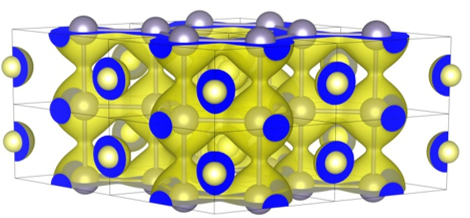
Module for Ab Initio Structure Evolution features
Neural network description of interatomic interactions
Evolutionary optimization of bulk, film, and nanoparticle structures
Structure analysis: space group solver, structure comparion, etc.

General information
MAISE is an open-source C code for parallel execution on Linux (version 2.9.01, Oct, 2023)
MAISE-NET is an open-source Python script for Linux (version 2.0, Jan 20, 2021)
MAISE-LAMMPS is an interface to use MAISE neural networks in LAMMPS runs (version 1.0, May 14, 2021)

Development team
Alexey Kolmogorov (developer, 2009-present)
Samad Hajinazar (co-developer, 2014-2020)
Ernesto Sandoval (co-developer, 2016-present)
Aidan Thorn (co-developer, 2019-present)
Saba Kharabadze (co-developer, 2020-present)
Maxwell Meyers (contributor, 2020-present)
Ethan Ferguson (contributor, 2020)

News and Announcements
Aug 2023 Multiple stable M-Sn alloys (M=Na,Ca,Cu,Pd,Ag) are predicted with NN potentials.
Jun 2022 New stable Li-Sn alloys are predicted with NN potentials.
May 2021 MAISE NNs can now be used in LAMMPS simulations.
Jul 2020 The 1st MAISE Webinar overviewed the code's key features. Webinar-20-07-30.pdf
May 2020 A review of MAISE and MAISE-NET describes key features and predictions.
May 2020 MAISE-NET Python-based automated generator of neural networks is released.
Dec 2019 NN models are shown to outperform classical potentials for guiding ab initio searches.
Apr 2019 Multitribe evolutionary algorithm is developed to accelerate prediction of nanoparticles.
Nov 2018 Neural networks are used to accelerate prediction of stable Mg-Ca alloys.
Aug 2018 MAISE and developed NN models are made publically available on Github.
Jan 2017 Stratified construction of NN models for multielement systems is developed.

Select Confirmed Predictions
2016-2017 We predicted NaSn2 to be an overlooked stable phase synthesizable at ambient pressure [31]. The phase has flat honeycomb tin layers, unusual for tin-based materials, and topologically non-trivial electronic features. The proposed NaSn2 material was discovered in a following independent work.
2006-2015 Predicted [8,9] and synthesized [30] LiB has the desired structural and eletronic features to be a long-sought-after analog to the MgB2 superconductor. The material's high-pressure synthesis and characterization was complicated by an unusually complex behavior of the starting LiBx compound.
2010-2013 Predicted [16,17] and synthesized [26] FeB4 is one of the first superconductors designed fully 'in silico': a new compound with a new crystal structure and unexpected BCS superconductivity for an Fe-based material. For more details see a APS viewpoint article and a Press release.
2012 An unexpectedly complex high-pressure tI56 crystal structure was synthesized and solved for the CaB6 compound [23,24]. The 28-atom ground state structure with unfamiliar 24-boron building blocks was found with our evolutionary search without any structural parameter input, e.g. truly 'from scratch'.